


Northbound Travel for Hong Kong Vehicles Scheme / HKZM Bridge insurance
As the top car insurance expert in Hong Kong, Kwiksure provides insurance plans covering two or three jurisdictions.
No matter what scheme you use to go to the Mainland or Macau, such as the Northbound Travel for Hong Kong Vehicles (NTHKV) Scheme or the Macao Port Park-and-Ride Scheme, we can offer you the relevant cross-border car insurance solutions.
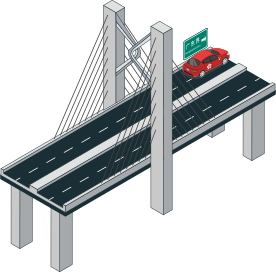

Kwiksure can help you secure Compulsory Traffic Accident Liability Insurance and Commercial Third Party Liability Insurance for the Mainland, significantly simplifying the insurance application process.

5-Seater Car
Compulsory Traffic Accident Liability Insurance (required by law)
As low as ¥665
Commercial Third Party Liability Insurance (RMB ¥1 million compensation)
As low as ¥681
^Calculated assuming the vehicle was registered more than 3 years ago
¥1346
(¥665 + ¥681)

7-Seater Car
Compulsory Traffic Accident Liability Insurance (required by law)
As low as ¥770
Commercial Third Party Liability Insurance (RMB ¥1 million compensation)
As low as ¥805
^Calculated assuming the vehicle was registered more than 3 years ago
¥1575
(¥770 + ¥805)
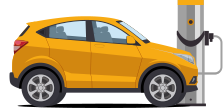
5-Seater EV
Compulsory Traffic Accident Liability Insurance (required by law)
As low as ¥665
Commercial Third Party Liability Insurance (RMB ¥1 million compensation)
As low as ¥910
^Calculated assuming the vehicle was registered more than 3 years ago
¥1575
(¥665 + ¥910)
Why should you secure independent motor insurance through Kwiksure?
1Your current insurer may not allow clients to extend coverage
Currently, not all insurers in Hong Kong take part in the "unilateral recognition" policy, meaning that your car insurer may not be able to add insurance for the Mainland to your existing policy.
2Some insurers may take a long time to issue policies
Due to the strong demand for additional coverage under the NTHKV Scheme, many insurers have to suddenly process a lot of applications, and it may take them weeks to approve your application for coverage under the "unilateral recognition" policy.
3Some insurers may charge a handling fee
Some insurers (or the relevant insurance intermediaries) may charge a handling fee before processing your application for "unilateral recognition" coverage.
4Your current policy is about to expire
If your existing car insurance has less than one month remaining, you may have to wait until your policy is renewed before applying for “unilateral recognition” coverage. This may create more inconvenience than it’s worth, and it could well be better to directly secure independent car insurance for the Mainland.
5Your official policy/official policy number has yet to be issued
If your existing policy has not been issued for whatever reason, your insurer may need to wait until the policy is officially issued before processing your application for “unilateral recognition” coverage. In that case, it may well be better to secure car insurance for the Mainland directly.
Learn by watching videos
[Car Insurance 101 EP8]
With money, the Home Return Permit, and a car ready, Gine planned to drive north but didn’t realize that the Northbound Travel For HongKong Vehicles insurance was a must before departing! Luckily, car insurance expert and CEO of Kwiksure, Ken, promptly informed Gine, providing clear answers to all questions regarding this insurance, ensuring it was sorted out before setting off!
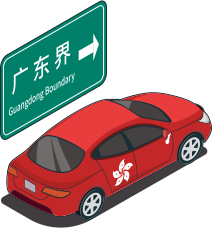
Introduction to the Northbound Travel for Hong Kong Vehicles Scheme
The scheme allows Hong Kong private vehicles to travel to Guangdong Province via the Hong Kong-Zhuhai-Macao Bridge (HZMB) on a self-driving tour for brief stays, without the need to apply for a permit under the “regular quota” system. Drivers can stay for up to 30 days each time, and spend up to 180 days in PRC per year.
Requirements for Securing Coverage for the Northbound Travel for Hong Kong Vehicles Scheme
- The insured driver must hold a valid HKID card
- The insured driver must hold valid driving license in the Mainland and in Hong Kong
- The insured driver must hold the official registration documents of the insured vehicle
- The insured vehicle does not have to have a 'Guangdong-Hong Kong vehicle license'
Types and Compensation Limits of Car Insurance in Hong Kong, Macau, and the Mainland
Death or bodily injury caused to a third party
HKD $100 million
Property damage caused to a third party
HKD $2 million
Compensation for death or bodily injury
RMB ¥180,000
Compensation for medical expenses
RMB ¥18,000
Property damage
RMB ¥2,000
Compensation for death or bodily injury (no liability)
RMB ¥18,000
Compensation for medical expenses (no liability)
RMB ¥1,800
Property damage (no liability)
RMB ¥100
Coverage of Compulsory Traffic Accident Liability Insurance for Motor Vehicle
CTALI for Motor Vehicle is the mandatory car insurance in the Mainland. It provides compensation to third parties for death, bodily injury or damage to property in a traffic accident involving the insured vehicle. However, it does not cover the insured vehicle itself, or its driver or passengers.
Examples of Compulsory Traffic Accident Liability Insurance for Motor Vehicle Premiums
Coverage of Commercial Third Party Liability Insurance (CTPLI)
CTPLI provides additional protection on top of CTALI, allowing the insured to increase the third-party liability compensation limit to the insured amount (without differentiation between death or bodily injury, medical expenses, and property damage).
Examples of CTPLI Plan Premiums
Exclusions of Compulsory Traffic Accident Liability Insurance for Motor Vehicle and Commercial Third Party Liability Insurance
- Driving without a license
- Driving while under the influence of alcohol, drugs, or state-controlled psychotropic or anesthetic drugs
- Hit-and-run accidents
- Accidents during the theft or robbery of the insured vehicle
- Accidents caused intentionally by the insured
- Losses in an accident intentionally caused by the victim
- Losses of the insured’s property and property on the insured vehicle
- Arbitration or litigation costs and other related expenses arising from a traffic accident
- Liability of passengers in the insured vehicle
- Liability claims made outside of Mainland China for accidents occurring in Mainland China

By subscribing to the newsletter, you accept and agree to Kuaibo's Terms of Service, Privacy Policy and Personal Information Collection Statement.


By subscribing to the newsletter, you accept and agree to Kuaibo's Terms of Service, Privacy Policy and Personal Information Collection Statement.